What is The Multiplier Zone?

frameworks the 1x effort trap the multiplier zone
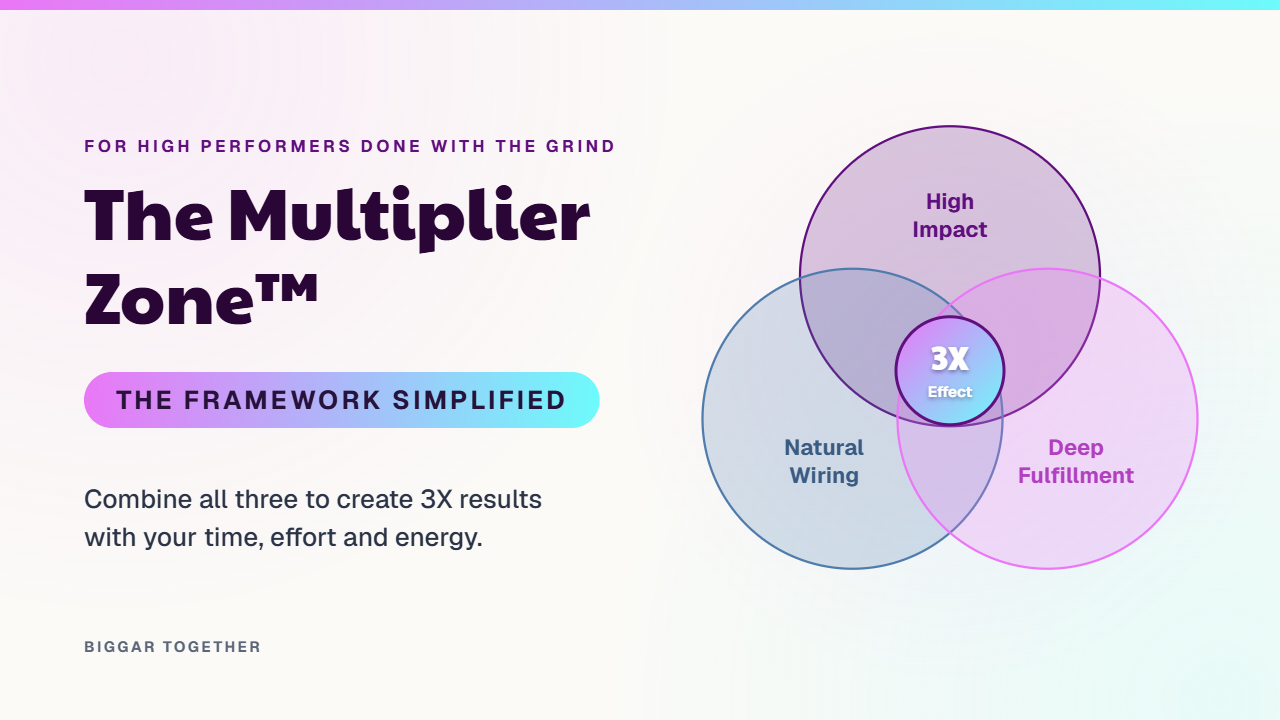
The Multiplier Zone framework: three overlapping circles labeled Natural Wiring, High Impact, and Deep Fulfillment, with the 3X Effect at the intersection of all three.

The Multiplier Zone™ is the overlap of three circles where the same effort multiplies into roughly 3X the results.

There is a formula underneath nearly everything you've built: more hours equals more success. Work more, get more. It has paid off so reliably, through every season of your working life, that you trust it the way you trust gravity.

Then one day it quietly stops paying. You put in the extra hours and the results barely move. The revenue line flattens no matter how hard you push, or the wins keep coming but start costing you in places no win can buy back, your health, your relationships, your peace.

Most people read that moment as a personal failure, a sign they need to want it more or push harder, but the failure isn't personal at all. The formula didn't stop working because you got less capable. It stopped because it was never built to carry you this far.

In brief
  • The Multiplier Zone is the overlap of three circles, high impact, natural wiring and deep fulfillment, where the same time, effort and energy multiply into roughly three times the results.
  • The ceiling a high performer hits is the linear model they are running, one unit of effort in for one unit of result out, which caps wherever their hours run out.
  • Each circle you switch on adds one to the multiplier, so one circle is the 1X grind, two circles give traction with a cost, and all three together give the 3X Effect.
  • Two of the three circles resist being switched on alone: others can spot your wiring more easily than you can, and deep fulfillment only exists in helping other people with your best.

The model you're already running

The default way a high performer works is linear: one unit of effort in, one unit of result out. Results equal effort, multiplied by one. It's an honest model, and for years it works, because when the input is your own effort, more input really does mean more output.

That reliability is exactly why you trust it, because it gives you a sense of control. You believe that if you just work harder, you'll get better results, and when the results are lacking, you tell yourself it's because you're not working hard enough.

But look at what powers it. The engine of the linear model is you, your personal hours, energy and push. An engine like that has a hard ceiling built into it, and the ceiling sits wherever your hours run out. Past that point the model has nothing left to give, however capable the person running it is, because more effort fed into a times-one equation still comes out the other side as one.

This is the wall: giving everything you have and watching your results plateau for months, even years, stuck just short of the success and opportunities you know you're capable of. The mistake is reading the cap as your capability, when it was only ever the model you were running.

Your capability outgrew the model that got you here.

So the way through the wall isn't a better work ethic, it's a better equation. The rest of this piece builds that equation the way I would draw it for you on a whiteboard, one circle at a time.

One circle on: the grind

The model starts with one circle: High Impact, the mission-driven work that creates opportunity, results and income, the circle that holds the way you earn. If you're like most high performers, this circle is already switched on, because it's the one your effort has always served. You take the work seriously, you deliver, the results are real.

It's also where that belief about working harder lives: when you want more, this is the circle you push.

One circle is a force, and it's also the whole grind. With only High Impact live, the equation is still results equal effort times one, so the ceiling sits exactly where your hours end.

The price shows up in the two circles still missing: the work rarely fits how you're built, so every hour costs more effort than it should, and too little of it gives anything back, so the energy drains even while the wins stack up. You can feel all of this long before you have words for it, winning and wondering why it costs so much.

Switch on the second circle: Natural Wiring

There's a certain kind of work you keep coming back to that costs you every single time. Not the hard-because-it's-new kind that gets easier as you go, but work you've done a hundred times and still have to force yourself through. Every pass takes willpower, and the willpower is the expense. You end those stretches drained in a way the hours alone don't explain, because the energy didn't go into the work, it went into making yourself do it.

That cost is friction, the mark of a second circle still dark: Natural Wiring, the work that fits your strengths, your passions, your values and your life experience. The work you were built for, rather than the work you've merely gotten good at through effort.

Switch this circle on, so the way you earn runs through how you're actually built, and the friction goes. The same hour lands differently when nothing in you is resisting it, and the multiplier climbs: results equal effort times two.

The model insists on a piece of honesty at this point. Two circles give you traction, and traction is real progress, but it's never a comfortable place to settle, because the missing circle always leaves a mark. High Impact plus Natural Wiring without the third is the impressive-but-hollow version: you win, the wins fit you, and you still catch yourself wondering why they feel empty.

Switch on the third circle: Deep Fulfillment

You close a win on a Friday afternoon, a real one, the kind you worked months to earn, and the first thing you feel is that the pressure is finally off. It isn't momentum or the pull toward what comes next, just the absence of the thing that was pushing you. You spend the weekend waiting to feel recharged, and Monday picks up exactly where Friday left off, which is not further along but the same flat line.

Somewhere in that flatness a familiar question surfaces, less a spark than a reflex: what's next? So you reach for the answer that has always worked, a bigger goal than the last one, and the cycle restarts, chasing more of something that never quite filled you the last time.

That's depletion, and the scene you just recognized is its signature: the flat win, the rest that doesn't recharge, the reflex reach for a bigger goal. These are the signs that the third circle is still offline: Deep Fulfillment, the work that serves others with the best of what you have.

Almost every high performer treats this circle as an optional someday-luxury, yet it's the only circle that nourishes the soul, recharging you through contribution to other people. This is why the recharge from a vacation fades within days and ticking off tasks feels good only for a moment: relief isn't the same as being refilled. When you're helping others with the best of what you have, you're aligned with your purpose. Switch this circle on and the work starts refueling the person doing it.

All three circles are now live, and the small region where they overlap is the whole point of the drawing. Work that creates real results, through how you're actually built, in service of others with your best. Inside that overlap the same time, effort and energy stop adding and start multiplying, and that overlap has a name: The Multiplier Zone.

One force. Two is traction. Three is the multiplier.

The three forces

 High Impact

The mission-driven work that creates opportunity, results and income. Removes futility: effort only flows to what moves the needle.

 Natural Wiring

The work that fits your strengths, passions, values and life experience. Removes friction: effort stops grinding against yourself.

 Deep Fulfillment

The work that serves others with your best. Removes depletion: purposeful effort improves wellbeing, engagement and results.

Where does the 3X come from?

The 3X comes from simple, honest arithmetic: each circle you switch on adds one to the multiplier, so all three together give you one plus one plus one, the 3X Effect. A number like that can sound invented, and I have no interest in borrowed authority, so let me be plain about what it is. It isn't a lab result, it's what the same time, effort and energy produce when they finally land in all three places instead of one. The room to grow was never in the circle you keep pushing, it was in the two you'd been ignoring, where the way you earn finally fits how you're wired and what recharges you.

1 + 1 + 1 = 3X

Each circle adds one and all three combine to give you the 3X effect.

Notice what the equation quietly settles, too. If the ceiling were about volume, the answer would be more hands: hire, delegate, outsource. Delegation matters, but it answers a different question, what to hand off.

The Zone answers the question nobody else is answering for a maxed-out high performer: what to keep. The work inside your overlap is the work only you should be pouring yourself into, while systems and other people carry everything outside it. Without that answer you delegate blind, keeping the wrong things and giving away the work that was actually yours.

Why only the center multiplies

Impact + Wiring

No Fulfillment. Impressive, but hollow. You win and wonder why it feels empty.

Impact + Fulfillment

No Wiring. You're working against yourself, relying on willpower to overcome friction.

Wiring + Fulfillment

No Impact. Enjoyable, but it doesn't pay, generating neither the results nor the income you need.

Isn't this just ikigai?

If you've seen the four-circle ikigai diagram, or Gay Hendricks' Zone of Genius, then three overlapping circles with a sweet spot in the middle will look familiar, and I get the comparison a lot. The shape rhymes, so it deserves a proper answer.

Start by separating the word from the picture. Ikigai itself is an old and broad Japanese idea, usually translated as what makes life worth living, a reason to get up in the morning. It needs no diagram, no career and no income to exist, and Japanese writers often locate it in ordinary daily life as much as in work.

The four-circle diagram that now carries the name, what you love, what you're good at, what the world needs, what you can be paid for, has a far shorter and murkier history. However it came to be, it does a different job: it turns a quiet idea about a life worth living into a career-fit exercise. It's a lovely idea, and neither the word nor the diagram is trying to do what this model does.

The honest family tree of the Multiplier Zone runs somewhere else. Its closest cousin is Jim Collins' Hedgehog Concept from Good to Great, three circles built for companies, reworked here for one person.

Where Collins asks what you could be the best in the world at, a comparison against everyone else, this model asks what fits your natural wiring, a fact about you that can actually be read. It also carries a circle Collins never drew, Deep Fulfillment, because that's the circle that decides whether the work drains you or refuels you.

Gay Hendricks' Zone of Genius, from The Big Leap, sits closer to this model than the ikigai diagram does, because it's built for one person. Hendricks names the meeting point of what you do best and what you love most; anyone who has worked inside that territory knows the feeling he's describing.

In this model that territory spans two circles, Natural Wiring for the gifts and Deep Fulfillment for the love. The second circle is asked to carry more here, because fulfillment isn't loving your work, it's helping others with the best of what you have, which turns enjoyment into purpose.

The circle the Zone of Genius never draws is High Impact, the one that decides whether the work creates opportunity, results and income. Sit squarely in your genius without it, and you have the enjoyable version that doesn't pay.

The deeper difference is the job. Those models are usually framed as discovery exercises: reflect until you locate your spot.

The Multiplier Zone is a practice you run at every stage, from discovery to mastery, and a live state rather than a trophy: you switch the circles on, you fall out of them, you switch them back on. The overlap itself has no end point, offering depth and discovery for as long as you keep mastering it. The question it answers is "where should I point my effort?", and you don't answer it through reflection alone, you answer it through connection and contribution. The ceiling was never a sign you chose the wrong work, it's a sign you've been running the right work on a single circle.

The difference

The ikigai diagram The Multiplier Zone
A discovery map for choosing vocation A practice you run from discovery to mastery
Asks: what should I dedicate my life to? Answers: where should I point my effort?
Usually framed as personal reflection Found through connection and contribution

Why these circles resist going solo

There's a catch in the model, and it lands hardest on the person who prides themselves on figuring everything out by themself: the two circles you've been ignoring are also the two that resist being switched on alone.

Natural Wiring is hard to discover by yourself because what makes you different is exactly what you can't see from the inside. You've spent years succeeding by overriding your wiring through sheer effort, so your real grain is buried under everything you built to compensate, and from the inside the compensations look like personality. Other people can spot your advantages more easily than you ever will, because they see you do work that looks hard to everyone else while it feels ordinary to you.

Strengths assessments and personality quizzes can help you understand yourself better, but most of them meet the same quiet fate: read once with interest, then lost on a hard drive, never applied to the work they were supposed to change. Applying the read is where community and support earn their place, because people who know you can guide you on what the results mean for how you actually work.

The change itself is no easier. Acting on your wiring alone means working in isolation, holding yourself accountable for the shift when you're already carrying so much.

Deep Fulfillment is a different case, and here the claim gets stronger rather than softer: this circle doesn't exist alone, because it is, literally, helping other humans with the best of what you have.

It's also the circle a successful business can hide. You can build something that works, run it in relative isolation, and miss the direct contribution entirely. You don't have to profit from the helping, although turning your contribution into the way you earn is the mastery worth building toward; the vehicle is yours to choose. Giving money to a cause you care about does real good, but the recharge this circle gives comes from helping someone directly with your best.

I learned all of this the slow way. For more than twenty years, from electrician to corporate communications to my own business, I ran the linear model flat out and carried a belief I was proud of: that I should be able to figure everything out on my own, without asking for help.

The work rarely fit how I'm wired, so I ran on willpower, discipline and caffeine. The wins that came felt strangely hollow, taking more out of me than they gave back, and I wore "busy" like a badge of honor while running on empty.

It was the isolation that kept me trapped, and connection and community that got me out.

What changed wasn't more effort, it was the quality of my questions once other people were in the room to help me answer them. "How do I work harder?" became "What am I naturally wired to contribute? What work fulfills me most? What creates the highest impact for others?" Those three questions are the three circles, and they're why my wife Jamie and I built Biggar Together, a place where high performers do this work alongside people who get it, instead of alone.

Run the build on your own week

The fastest way to find your Zone is to run this build backward over the week you just lived. Take last week and lay it out block by block, and against each block ask the three questions plainly. Mark only the blocks where all three were true.

  • Did this move what actually matters to me?
  • Did it fit how I'm wired?
  • Did it give something of my best to other people?

For most high performers that honest count is uncomfortably small, and the gap between the week you ran and the few hours that sat inside all three circles is the whole opportunity. You don't need more hours, you need more of your existing hours inside the overlap.

Then do the part most high performers skip, and now you know why it can't be skipped: take your read of the two circles to someone who can mirror them back, a peer, a coach, a community. Ask them where they see you at your best, and pay attention to what work you were doing when they answer.

Key takeaway

The room to grow was never in the circle you keep pushing, it was in the two you've been ignoring. You don't add more effort, you multiply what the same effort is worth.

You already have the effort. The Multiplier Zone is where the same effort finally counts for three times as much.

Frequently asked questions

What if my current work can't fit all three circles?

Usually the work doesn't need replacing, the effort inside it needs reallocating. The Multiplier Zone is a diagnosis of where your existing hours land, so the first move is shifting more of them toward the blocks that already sit in all three circles. Often the real adjustment is aligning the way you earn with how you're wired and what recharges you, rather than changing what you do. A full change of direction is the rare outcome, never the premise.

Isn't chasing fulfillment just lowering the bar?

No, because Deep Fulfillment is the circle that recharges you, so you can do more of what matters, not less. Fulfillment in this model isn't a softer goal, it's serving others with the best of what you have, which returns energy that ambition can spend. Cutting it out doesn't make you more serious about results, it just means the work only ever takes energy from you, so rest keeps patching you up while the drain stays on.

How do I figure out my natural wiring?

The honest answer is that it's hard to do alone. Start with the evidence you already have: the work that comes easily to you but looks hard to others, what people keep coming to you for, what energizes you versus what drains you. Then get an outside read, because your wiring is buried under years of compensating through effort. Ask people who see you at your best where they see it, and consider a proper assessment for the read introspection can't give.

Frameworks referenced

Join the next Freedom-First Business Lab

Connect with us to create momentum together with clarity and purpose

Leave with a 30-day plan in less than 60-minutes

Register Now